
Garage and overhead door repair in Haysville, for post-war ranches, the subdivisions built from the seventies through the nineties, and the newer homes on the edges of town. However you call it, overhead door or garage door, tell us what it's doing and you'll get a free estimate.
Tell us what the door is doing. The estimate is free either way.
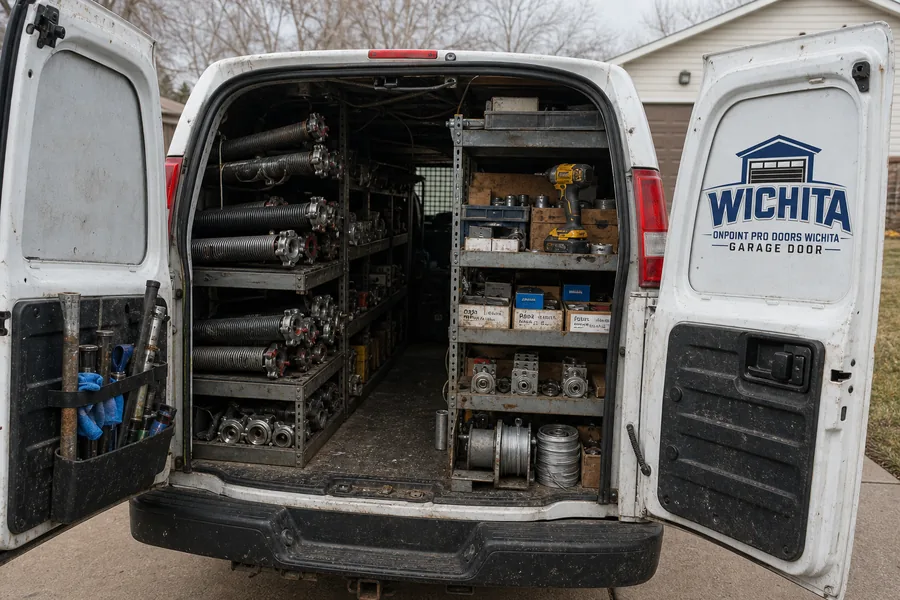
Plenty of people here call it the overhead door, and the name fits: it rolls up and over into the garage on a pair of tracks. On a house or on a shop, the parts that wear out are the same ones: the springs that carry the weight, the cables that lift it, the rollers that guide it and the opener that drives it. A call for overhead door repair gets exactly the visit a call for garage door repair does.
The size is what changes. A single door on a house takes light hardware; a wide door on a shop takes heavier springs, thicker cables and a stronger operator, and those ride along when you tell us which one it is.
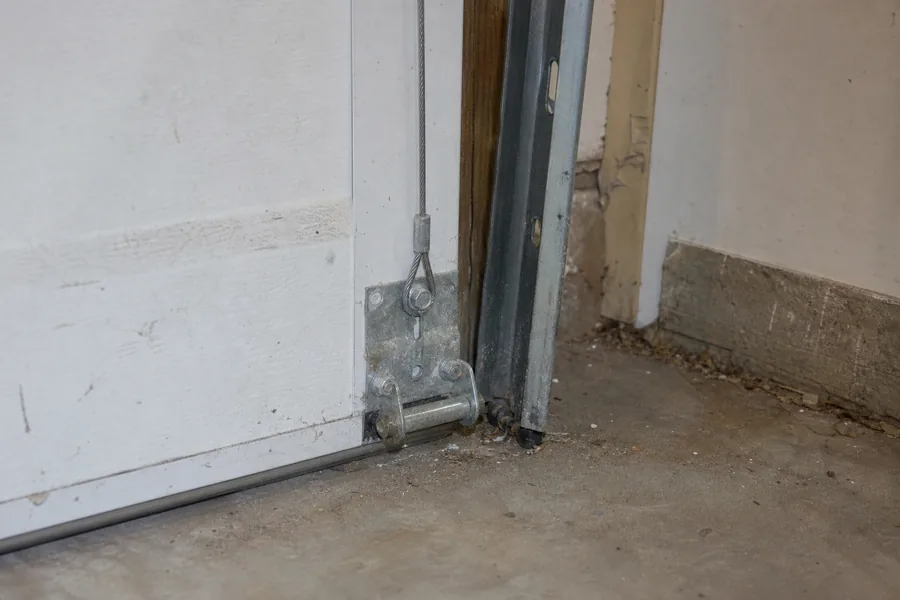
The oldest houses in town tend to have a one-car garage, sometimes widened years later, with a door that has been re-sprung more than once. Those doors often carry a mix of parts from different repairs over the decades: a newer spring on one side, original hinges, rollers of two different kinds. Replacing the worn pieces as a set, the springs as a pair and all the rollers at once, gets a door like that running smoother than patching one part at a time.
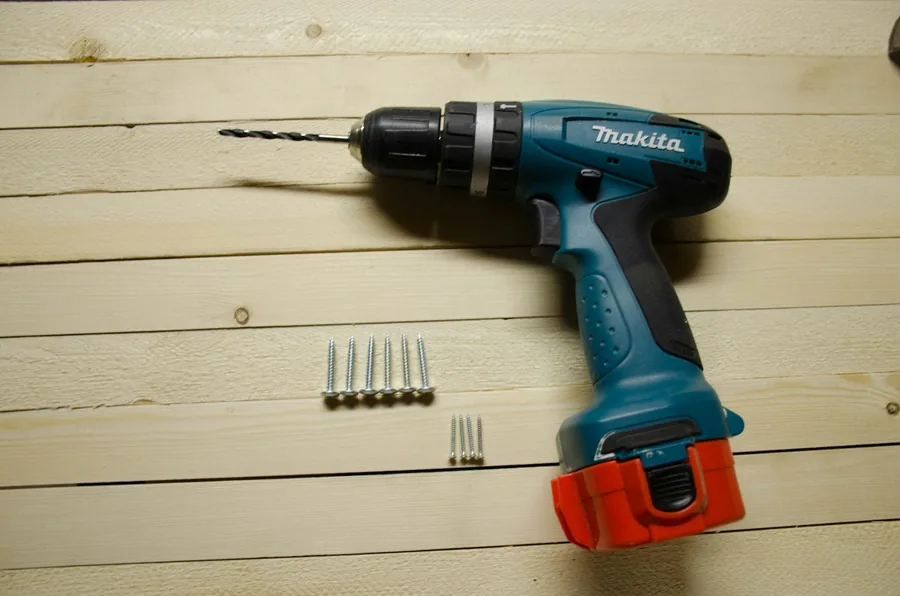
Two-car doors on houses from those decades are usually on their second or third opener and sometimes still on their first tracks. The calls that come from these streets are a spring that finally gave out, an opener with a gear worn smooth, and a door that now binds at one spot because a track bracket worked loose from the wall. When the parts are on the truck, each of those wraps up on the first visit.
Five steps, and they don't change.
The openers in town are mostly LiftMaster, Chamberlain or Genie, with some older Craftsman units still running. When one stops, the cause is usually one of four: a drive gear, the two floor sensors, the logic board, or the remotes. If the unit is old enough that its remotes still use fixed codes, a new rolling-code opener deserves a look; otherwise the old one gets repaired and goes on working.
A broken spring announces itself with a sharp bang and a door that won't lift. A cable problem shows up differently: the door hangs lower on one side. Either way the door shouldn't be forced. Stop using the opener and keep people clear. The springs go in as a matched pair picked for the door's weight, and a frayed cable is replaced on both sides.
If a door has been getting heavier for months, the springs are close to the end, and a planned replacement is much less trouble than waiting for the bang on a cold morning.
Overhead doors on shops, detached garages and small commercial buildings along the main roads get the same care: springs, cables, rollers, tracks, operators and photo eyes, with heavier parts for wider and taller doors. A roll-up door that sticks halfway is usually a spring losing tension or a guide bent by a vehicle.
A door that's turned noisy is usually telling you something specific. A grinding sound often means worn rollers; a squeal, dry hinges or springs; a bang at the top or bottom of travel, an opener whose travel limits have drifted. A shudder as the door moves can mean it has gone out of balance. A service visit pins down which one it is and fixes it on the spot.
A door with several damaged sections, rust through the steel or a warped wood panel is usually worth replacing. The opening is measured, the choices are explained, including insulation for an attached garage, and the old door is hauled off once the replacement is hung.
Derby, Clearwater and the south edge of Wichita are neighbors along the route, and any street in town is an ordinary stop.
No. Overhead door is another name for a garage door, whether it's on a home or a shop.
Most often the rollers have worn or the hinges are dry; sometimes the door has lost its balance. One service visit usually quiets it.
A cable has likely jumped its drum or broken. Keep the door still and call.
Usually. Gears, sensors, boards and remotes are replaceable for the common brands.
Yes, for shops, detached garages and small businesses, whether the door is sectional or roll-up.
If the door has two, yes. Both springs aged together, so the survivor won't last long alone.
Often a spring losing tension or a guide bent by a vehicle. Both are repairs, not a new door.
Nothing, unless you want it to. It's free, and you choose.
Phone or use the form to get on the schedule; the technician calls before arriving.
Estimates are free and on paper, and work waits for your approval.
Describe the symptoms and you'll get an arrival window, not a guess. The visit and the estimate is free, anywhere in Sedgwick County.
Would rather call? Call (316) 749-2780.
Tell us what the door is doing. The estimate is free either way.