
Automatic gates that drag, stall, hum or won't close, repaired with the operator and the gate looked at together, usually in one visit. The estimate is free.
Tell us what the door is doing. The estimate is free either way.
If an automatic gate has slowed down, stopped halfway, started sagging or picked up a new noise, you're on the right page. We work on powered swing and sliding gates across the county, from subdivision driveways to acreage entrances off the section roads, along with the operators, controls and safety devices that run them.
Most gates here are ordinary: steel double leaves on linear arms, an aluminum slider on a chain operator, an ornamental iron gate with a solar panel on the post. What fails on those is what we carry.
Acreage gates tend to run on solar, because trenching power out to a post far from the house is a big project. Subdivision gates are more often wired from the house or a nearby panel. Both kinds come through the same schedule, and both get the same look at the gate before the operator.
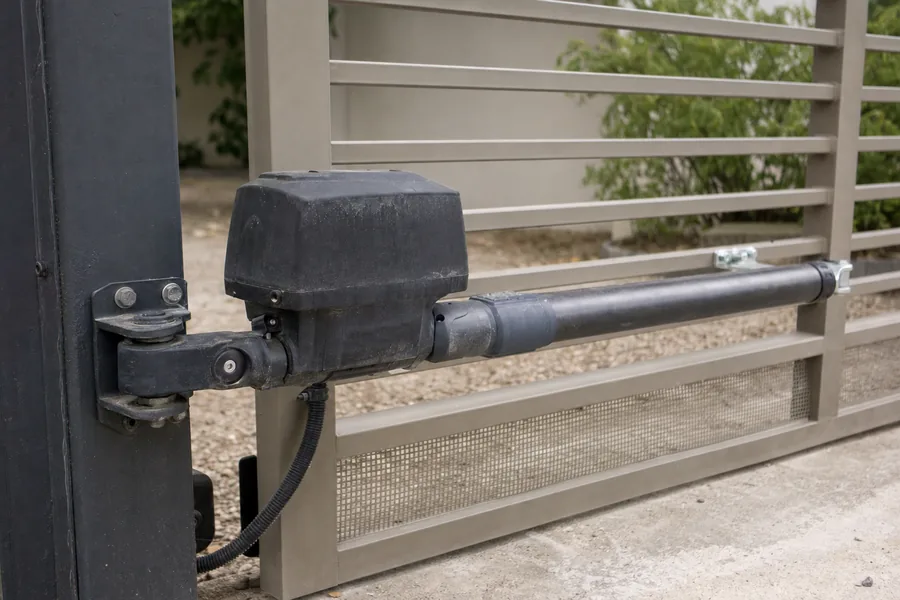
The operator usually takes the blame. Sometimes that's earned, but more often a smaller part is the real fault, and it's a same-visit repair.
Everything on a gate lives outdoors. Straight-line wind and spring hail dent panels and bend tracks, ice storms freeze rollers and hinges, and summer heat wears on batteries and control boards.
Wind catches people off guard. A solid-panel leaf acts like a sail, and a hard gust against a half-open gate can bend an arm or rip a bracket off the post. An operator set to hold against the wind, and a leaf that isn't left standing open through a storm, prevent a lot of those calls.
Hail is the other one. A solar panel on the post takes the same hits as a car hood, and a cracked panel charges poorly long before anyone notices. The gate slows down over a few weeks and then quits during a cloudy stretch.
Every operator has a force setting. As a gate starts to bind, the force gets turned up, the safety reverse becomes less sensitive and the motor runs hot. A new operator on a dragging gate fails the same way, just sooner.
That's why the first part of a gate visit looks nothing like electrical work. The arm is released, the gate is swung or rolled by hand, and hinges, rollers, posts and track are checked before anyone opens the operator box.
If the gate itself needs work, you hear that first: a hinge worn oval, a post that has started to lean, a slide track packed with gravel and dirt. Those get dealt with before anyone passes judgment on the operator.
The operator is only one half. Everything that tells it to move is the other: remotes, keypads, exit loops, intercoms, phone entry and timers. When those fail, the gate looks broken when it's really a control problem.
We program remotes and codes, replace keypads and receivers, fix or recut exit loops, and bring older controls up to date where the parts still exist.
Timers and hold-open settings get a look too. A gate set to stay open for a party last summer and never set back is a common find, and so is a keypad code half the neighborhood knows.
Most gate repairs are finished in one visit because the parts that fail are the ones on the truck.
The operators on gates around here are mostly Ghost Controls, GTO, FAAC, Elite, Linear, DoorKing, Viking, Nice and Apollo, Mighty Mule and LiftMaster. Common parts for all of them ride along, and most others can be sourced.
The question we hear most is whether an older operator is finished. Usually it isn't. Boards, batteries, transformers, arms, chains and gears can all be replaced, and an operator sized properly for its gate can run for many more years after a repair.
When a new unit does make sense, it's chosen for the gate as it actually is, and the gate is made to swing or roll freely first. A well-sized operator on a free-moving gate lasts; the same operator on a binding gate won't.
Whether the operator shows any light, whether it's solar or wired, whether it hums or stays silent, and whether the gate is stuck open or shut. Those details decide which parts ride along.
If the gate is stuck open, lead with that. A property standing open to the road moves up the list, just like a garage door that won't shut. If a car is trapped behind it, mention that too.
Sometimes the operator really is at fault: a burned motor winding, a dead board, a failed transformer or charger, a photo eye or the receiver. A meter at the box identifies which, and most are fixed on the spot. When an operator truly is finished, you hear why, and what a correctly sized replacement involves, before anything is ordered.
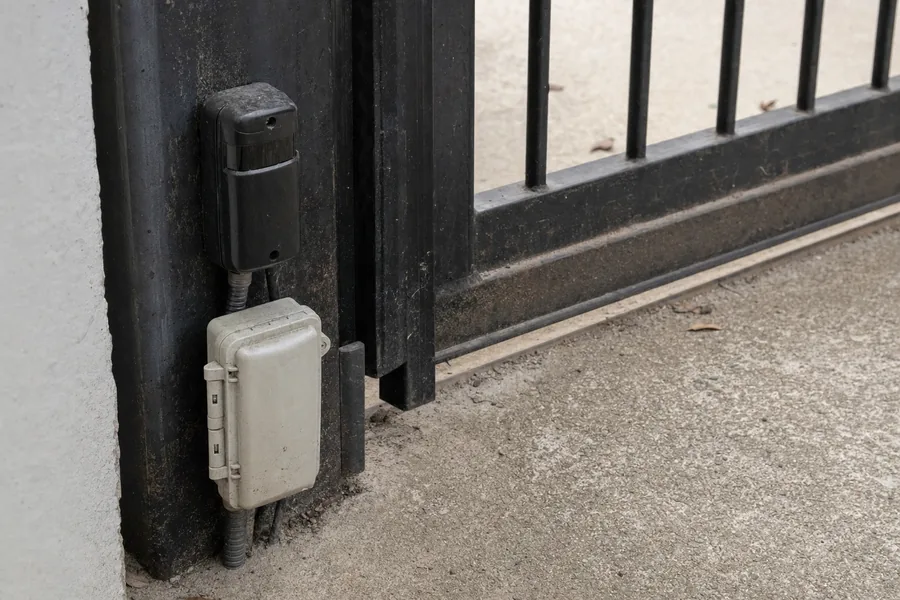
The usual cause is a safety device doing its job: an eye with dirt or a cobweb across it, an eye nudged off target, or an edge that's been damaged. The eye is lined up again or replaced, never bypassed.
Most of the time, because the failure-prone parts for popular brands travel with us. Anything that needs ordering is flagged before the technician leaves.
We handle it as one. A property open to the road gets the same priority as a garage door stuck open, and a gate that can't be finished on the first trip is left shut and secured.
Usually, since they fail piece by piece. It's time for a new unit when the motor has burned out, parts for the brand have dried up, or the operator was never big enough for the gate.
If it's metal, swings or rolls without a fight, and hangs on sturdy posts, yes. We confirm all of that first, because automating a gate that binds just creates a service call.
Yes, along with receivers, intercoms, phone entry and the loops in the drive. Many so-called operator failures turn out to be one of these.
Yearly, since gates live outdoors. A tune-up covers hinges and rollers, track, battery, photo eyes and reverse, and it catches most problems before a car gets stranded. Gravel drives add one more item: a slide track fills with stones and grit faster than one on a paved drive.
A single call sets a two-hour slot, and the technician phones before heading your way. We don't buy leads, and no one diagnoses a gate by phone.
Estimates are free, and they come before any work.
Describe what the gate does and you'll get a two-hour slot. Visit and estimate are free anywhere in Sedgwick County.
Would rather call? Call (316) 749-2780.
Swinging or sliding, and the symptom. Estimates here are free.