
Operators that hum without moving, stop halfway or ignore the remote, on swing and sliding gates, solar and hardwired. Most are fixed in one visit, and the estimate is free.
Tell us what the door is doing. The estimate is free either way.
An automatic gate opener is a small machine that lives outside all year: a motor, a gearbox, a control board full of settings, a battery or transformer and a set of safety devices, all sitting in a box on the post through heat, hail and ice.
We repair operators on swing and sliding gates, single and double, on the driveway in one visit whenever the parts are ones we carry, which covers most of what fails.
Most of the operators we see here sit on acreage drives and subdivision entrances, and a fair number run on solar because the post is a long way from the house. That changes what fails first: batteries and panels on solar units, transformers and low-voltage runs on wired ones.
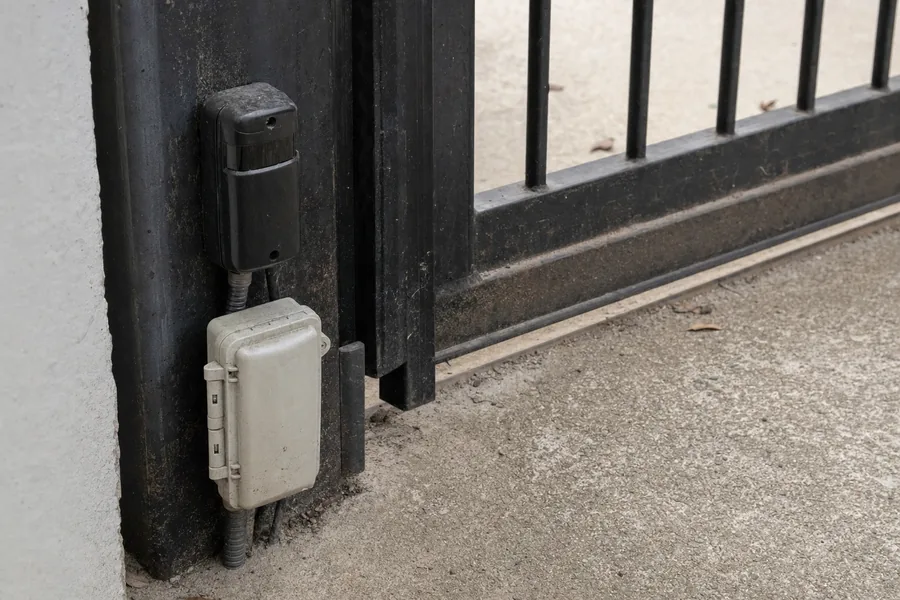
Operators fail in a short list of ways, and the symptom usually points to one before the cover comes off:
Eyes watch the opening, edges sense contact, loops in the drive sense cars. Each one can hold the gate open, so they're tested one by one until the culprit shows up. A failing loop can also open the gate on its own in wet weather, which is often the first sign.
We won't disable a safety device to get a gate to close, and we say so up front. Fixing the device is nearly always faster than arguing about it.
Every operator job begins at the supply with a meter: transformer, battery, solar panel, fuses, then the board. A gate that works some days and not others is usually a power problem, not a mystery.
Battery and solar units lose capacity slowly, so the first sign is a gate that handles fewer trips than it used to, or dies after a string of gray winter days. The battery gets load-tested, not just checked with a meter.
Hail matters here as well. A panel with a cracked face still looks fine from the drive, but it charges far less than it used to, and the battery drains further each day until the gate stops.
Every control, from remotes and keypads to exit wands, loops, intercoms, phone entry and apps, feeds one input on the board. So a control fault gets traced at the board first, then out to each device.
If a metal building, a new fence or a new router went up near the gate around the time the range dropped, mention it. Each one can cut the signal, and each has a fix.
Range also fades as a receiver ages. A new receiver with its antenna mounted up high and clear of metal often brings the range back without touching the operator.
Swing operators push and pull an arm; slide operators drive a sprocket on a chain or a gear on a rack. The board, the safety devices and the controls work the same way on both, and so does the diagnosis.
Underground swing operators are different. They sit in a box beside the hinge and collect water, so their trouble starts with seals and drainage before anything electrical.
On sliders, the rack or chain and the rollers take most of the wear, and a gravel drive grinds them faster. A slide operator straining against a dirty track shows the same symptoms as a failing motor, which is why the track is checked first.
A two-hour slot, a heads-up before the technician leaves, and a routine that starts at the power and finishes with the remote in your car.
Wind, hail and ice storms wear on outdoor electronics faster than most people expect. Summer heat cooks capacitors and batteries, spring storms take out boards with surges, and ice seizes arms and slide tracks.
Housings that sealed tight when new don't stay that way. A good part of any winter visit is finding water where it shouldn't be.
Ice is its own problem. An arm frozen at the pivot or a slider frozen to its track trips the operator's overload, and running the motor again and again against it can burn it out. If the gate is iced in, call and say so.
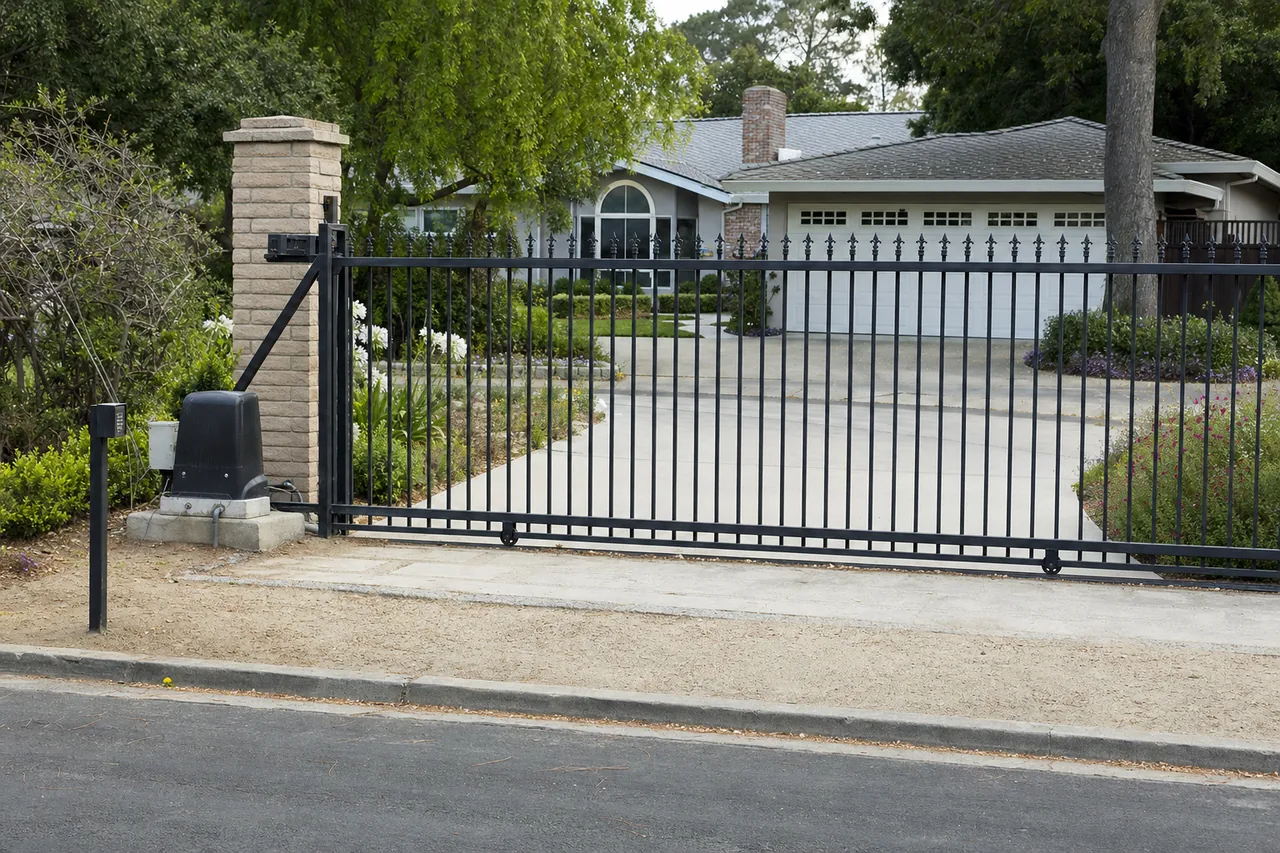
Most operator faults come down to one part. A new unit makes sense when the brand is orphaned and no board can be found, when the operator was too small for the gate from the start, or when motor and gearbox are both worn.
The replacement is matched to the gate's weight and daily traffic, and it goes in only after the gate swings or rolls freely by hand.
Where there's no power at the post, solar is the usual answer, with the panel and battery sized for short winter days rather than long summer ones.
Common makes here: LiftMaster, Viking, Eagle, Mighty Mule, US Automatic, All-O-Matic, Ghost Controls, DoorKing, Nice Apollo, Elite and FAAC, plus light commercial units. Common parts ride on the truck.
Whether the box shows a light, whether the unit is solar or wired, whether it hums, clicks or stays silent, and whether a storm came through before it quit. Those details decide what rides along.
One thing to avoid: wiring around a photo eye or an edge so the gate will close. It's the one shortcut that injures people, and we won't leave a gate that way.
AC units: typically a failed start capacitor, which is on the truck. DC units: more often a flat battery, or a gate that now drags too hard for the motor.
Rarely. A safety device is usually the one refusing, so each eye, edge and loop is tested in turn.
We do: the battery, the charge controller, the panel and its wiring, and the operator. The typical finding is a worn-out battery, or a panel that's dirty, shaded or cracked by hail.
Most brands are workable; the circuitry, safety inputs and controls follow the same logic across makers, and a photo of the label helps us bring the right parts.
No. The eye holding the gate open is protecting people and cars, so the eye gets repaired.
Most days. An open gate is treated as a security problem, so it goes ahead of routine work; tell us if it's been standing open overnight.
Yes. The diagnosis and the plan come before any work, you can decline, and if a part is on order the gate is left closed and secure.
One call gets a two-hour slot and a phone call before the technician heads out. We don't buy leads, and no one diagnoses a gate by phone.
The estimate comes first, and it's free.
Describe the operator's symptoms and you'll get a two-hour slot. Visit and estimate: free anywhere in Sedgwick County.
Would rather call? Call (316) 749-2780.
Hum, click or silence, solar or wired. Estimates here are free.