
Storm season and ice season are when doors here quit at the worst hour. A door bowed in by wind, a door iced to the floor, a door that won't come down at night: tell us which one, plus anything that's trapped or left exposed. Securing the door comes before fixing it, and the estimate is free.
Tell us what the door is doing. The estimate is free either way.
Straight-line wind can push a closed door inward hard enough to bow the sections and pop rollers loose from their track, leaving the door hanging crooked or jammed halfway, and a gap at one side lets rain and dust into the garage. Don't try to force it up or down, and don't run the opener; a door out of its track can fall. Keep people and pets clear and call. Shop and warehouse doors have their own page: commercial garage door repair.
The first job is making it safe: the door is braced or brought down under control, then the track, rollers and hinges are checked. Often it goes back into service on the same visit. A badly creased section may need ordering, in which case the opening is secured before the technician leaves.
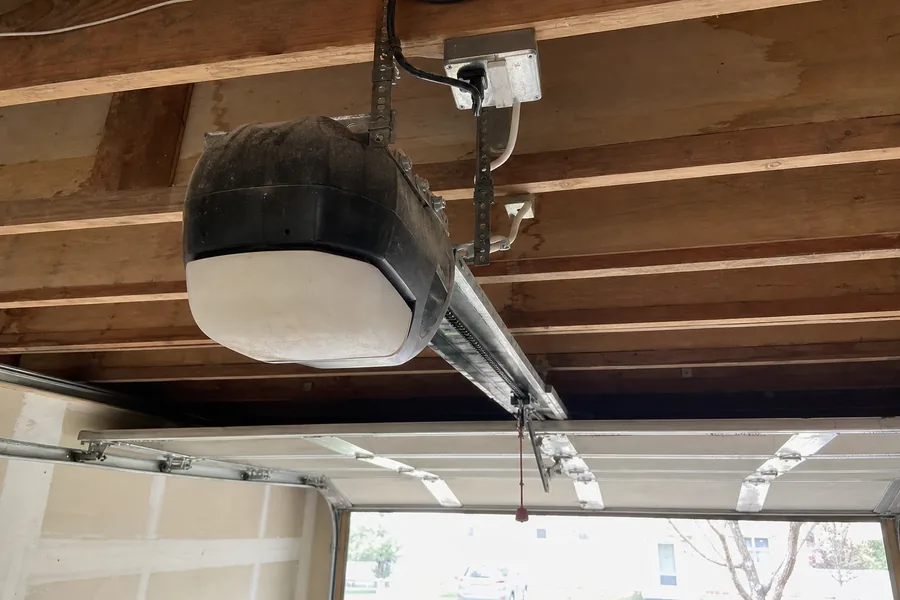
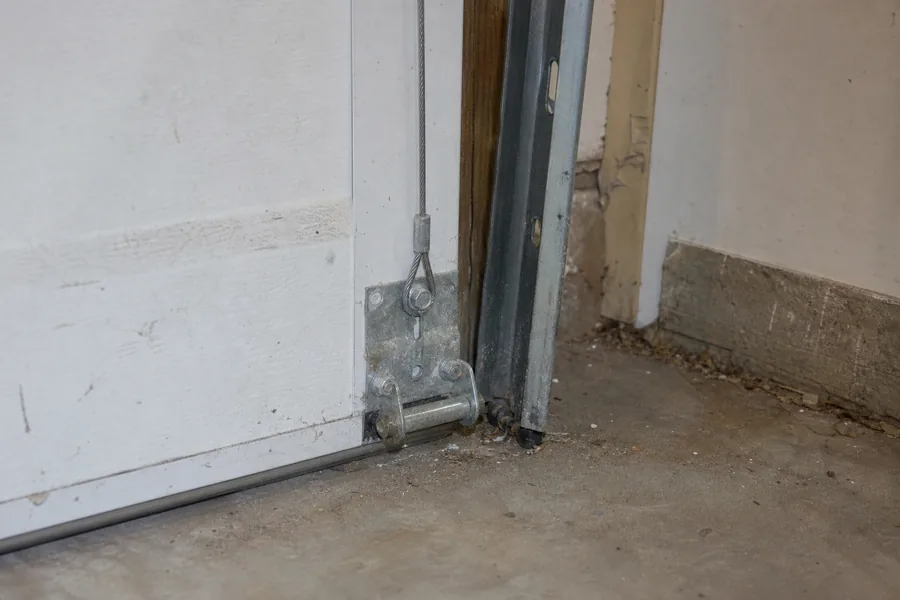
After an ice storm the bottom seal freezes to the concrete and, overnight, rollers can freeze in the track. The opener pulls, the door won't budge, and either the opener strains or the seal tears loose. Stop pressing the button; forcing a frozen door is how cables jump their drums. Often the door lets go by itself as the day warms, but if the car has to get out now, call.
The visit frees the door without ruining the seal or the opener, then checks what the strain may have done to the cables and springs. A new bottom seal and a clean track make the next ice storm a smaller event.
A lot of calls come before dawn from people heading to a plant or the base: the door won't open and the car is behind it. The usual cause is a broken spring. If that's your situation, say so when you call; those calls are scheduled ahead of doors that are only noisy or slow.
Meanwhile, leave the opener off and the release cord alone. A door with a broken spring is far heavier than it looks, and it's safer to wait for the pair that balances it than to try lifting it with a helper.
At any hour the order stays the same.
Hail rarely stops a door by itself, but it dents the lower sections and, with enough wind behind it, bends the track where it's exposed. A dented section can still run; a kinked track can't, because the rollers catch in the kink and the door binds or jumps out. That's usually a same-visit repair: the track is straightened or replaced and the door realigned.
Badly dented sections can be replaced one at a time on many doors. That's usually a scheduled job after the emergency is handled, written up separately so you can decide when.
Once the weather settles, look the door over from inside with the lights on: rollers sitting outside the track, a cable hanging slack on one side, a section with a fresh crease. Any of those means leaving the opener off until it's looked at. A door that looks fine but sounds different, a new grinding or popping on the way up, is worth a call before the next storm leans on it.
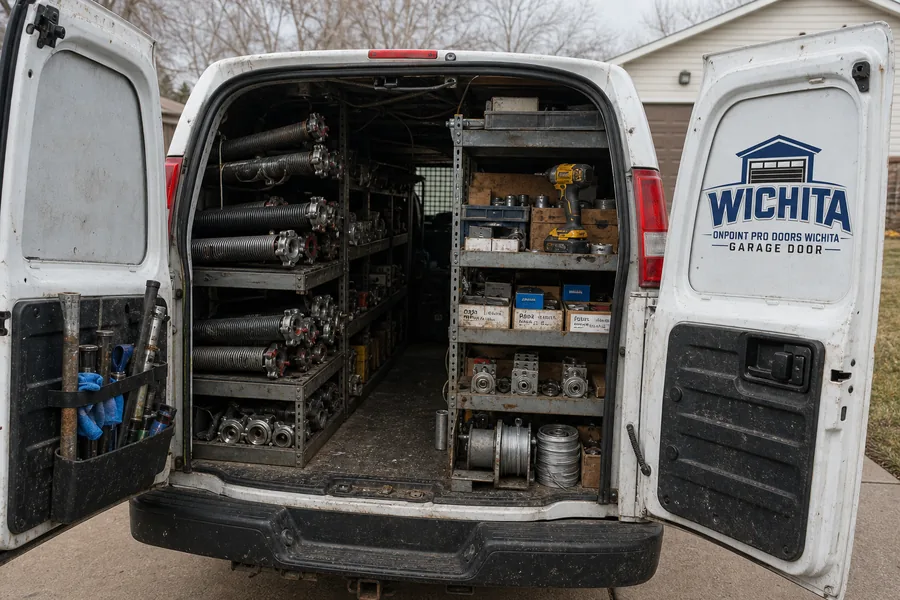
Across the city, including Riverside, College Hill, Delano, Crown Heights and Westlink, and out to Bel Aire, Park City, Maize, Goddard, Haysville, Derby and Andover. The truck carries springs, cables, rollers, track and opener parts for night calls.
Give us the street and nearest cross street when you call.
Safety before speed. A door that can fall is secured before anything else.
No forcing frozen doors. Freeing them properly saves the cables and the opener.
No house left open. When a section has to be ordered, the garage is closed up before we drive off.
The same estimate at night. Written, free, and your decision.
Keep everyone clear, leave the opener off, and call. A door out of its track can drop; bracing it comes before anything else.
Stop pressing the button. It often frees as the day warms, but if you need the car out, call and we'll free it without tearing the seal.
Say the car is inside. A snapped spring is the likely reason, the replacement pair comes with us, and trapped cars get the earliest slots.
Usually, if the track isn't bent. If the door binds or makes new noises after a storm, have it looked at before it jumps the track.
Yes, sectional and rolling doors on shops and warehouses, with the building secured first.
They do. It's written out before any work, whatever the hour.
Watch and listen the first time. A new grinding, a lean to one side or a slack cable means leave it off and call.
Call or use the form, say what the door is doing, and you get a two-hour window plus a heads-up call once the technician is rolling. Early-morning and evening slots go first to anyone whose car is stuck inside.
The estimate is free anywhere in the county and the towns around it.
Describe the symptoms and you'll get an arrival window, not a guess. The visit and the estimate is free, anywhere in Sedgwick County.
Would rather call? Call (316) 749-2780.
Tell us what the door is doing. The estimate is free either way.