
Plenty of people here leave for a plant shift or the base before it's light, and that's usually when they find out: the opener hums, the door rises a hand's width and quits. That's a spring. Leave the door down and call; the pair for your door comes on the truck, and the estimate is free.
Tell us what the door is doing. The estimate is free either way.
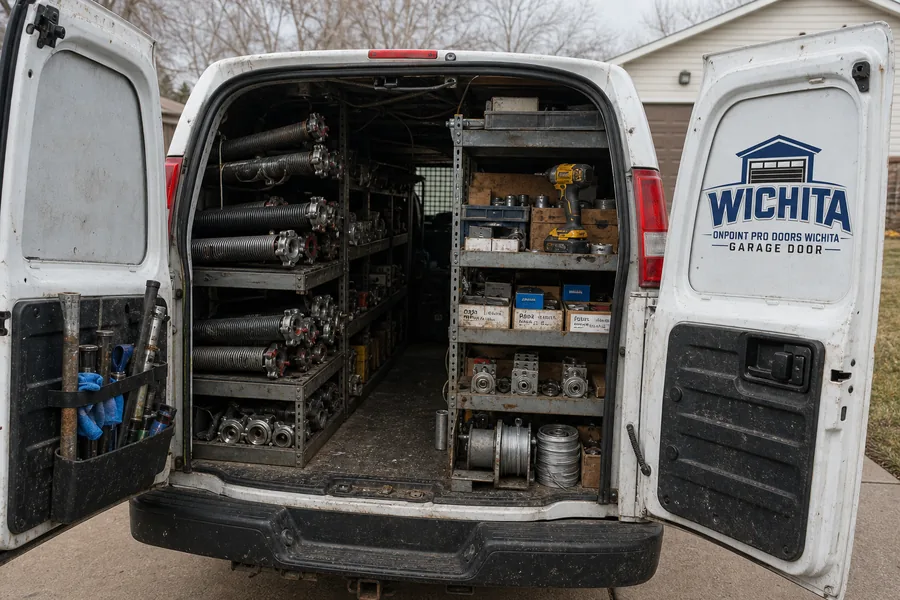
On the east side a lot of the houses are 1950s ranches with an attached single garage. Those doors are light, and many still hang on extension springs, the long coils stretched beside the overhead tracks. When one of those snaps it can whip across the garage, which is why each should have a safety cable running through its middle, and plenty of older setups never got one. On the newer streets to the west and northwest, the garages are brick two-car builds with a steel door on a pair of torsion springs over the opening, and those usually fail one spring at a time, leaving the door suddenly heavy and lopsided.
Either way the fix follows the same idea: springs sized to what the door weighs now, installed as a matched pair, with the door balanced by hand before the opener takes over again. What changes is the hardware that rides along, so it helps to know which kind you have when you call.
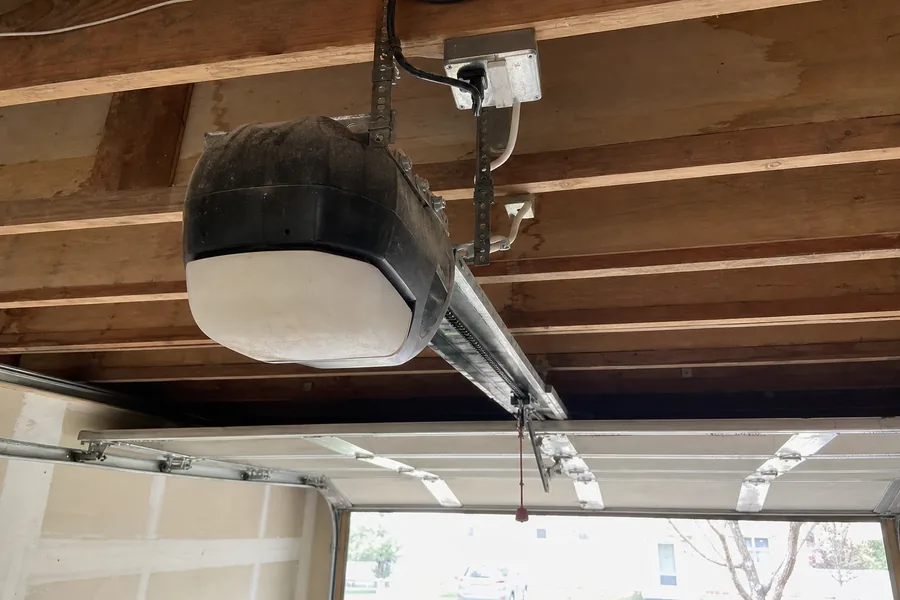
The break itself usually happens with the door closed and the spring under full tension, often overnight when the garage is coldest. Some people hear a crack like a board splitting; others hear nothing and find it at breakfast: the opener runs, the chain moves, the door barely rises. Look up and the coil above the door has a gap in it, or one of the side springs hangs slack.
From there, the less the door moves the better. Every press of the button makes the opener drag dead weight, and the drive gear inside it wears or strips. Leave the emergency release alone while the door is partly open; with nothing holding it, it comes down hard. If the car has to get out, lead with that when you call.
Springs here don't only wear out from use. A warm afternoon, then a hard north wind and a freezing night, puts real stress on steel that's already near the end of its life, and a coil with a small crack lets go on the cold side of that swing. Ice storms add a second load: a door frozen to the slab gets yanked by the opener, the cables snap tight, and a tired spring takes the shock.
That's why a spring job here always includes the bottom seal and the rollers. A seal that freezes down every ice storm and rollers that drag in a gritty track make the springs and the opener work harder all winter long.
The same steps whether it's a single door in an old ranch or a double in a new build.
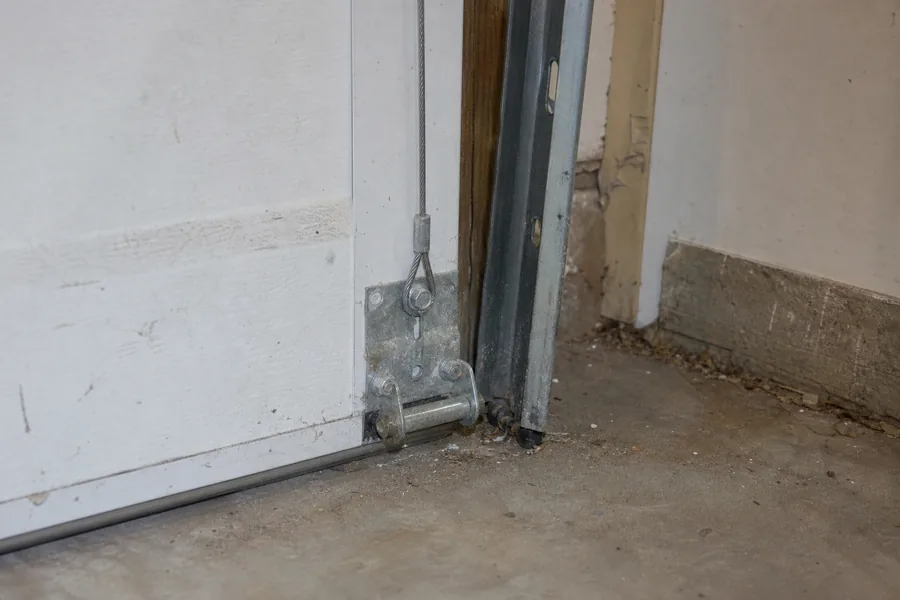
With the springs off and the door resting on the floor, the rest of the lifting system is easy to see. The cables should be smooth where they wrap the drums; fraying down at the bottom bracket means they're next. The bearing plates that carry the spring bar at either end should spin without grinding. Rollers with cracked or flat-spotted wheels make the door shudder and add drag. On extension-spring doors, the pulleys and safety cables get the same attention.
Each of those goes on the estimate as its own line with a plain reason. Some are worth doing now because the door is already apart; some can wait, and you're told which.
Riverside, College Hill, Delano and Crown Heights are mostly older single doors; Eastborough, Westlink and the northwest subdivisions lean toward two-car doors. The same truck runs out to Bel Aire, Park City, Maize, Goddard, Haysville, Derby and Andover with the common spring sizes on board.
Give us the street and you get a window you can plan the morning around.
Extension springs get safety cables. If yours don't have them, they're added.
A two-spring door gets two new springs. The one that didn't break is just as old.
The opener isn't blamed for a spring. Once the door is balanced, most openers are fine.
Nothing is replaced before you've read the estimate. Saying no is always fine.
If a long spring runs beside each overhead track, extension springs. If there's one coil or two on a bar just above the closed door, torsion. Either way, describe what you see when you call.
Tell us the car is inside. A broken spring is the usual cause and it's fixed on the visit; early calls get the earliest window we have.
No. The door is heavier than the remaining spring can hold, the opener strains, and the second spring is close behind. Leave it down and call.
A worn coil cracks most easily in the cold, and a sharp drop after a warm day adds stress. The spring was already tired; the cold finished it.
Yes, the suburbs and small towns around the county are on the same schedule. Tell us where you are when you call.
Yes. It's written before any work starts, and no is always an acceptable answer.
Call or use the form, say what the door is doing, and you get a two-hour window plus a heads-up call once the technician is rolling. Early-morning and evening slots go first to anyone whose car is stuck inside.
The estimate is free anywhere in the county and the towns around it.
Describe the symptoms and you'll get an arrival window, not a guess. The visit and the estimate is free, anywhere in Sedgwick County.
Would rather call? Call (316) 749-2780.
Tell us what the door is doing. The estimate is free either way.