
Machine shops, distribution warehouses, auto bays and storage lots across the area all depend on wide doors that open before the first shift and take the brunt of plains weather. OnPoint Pro Doors Wichita repairs the overhead, rolling and roll-up doors that keep those businesses moving. Free estimate either way.
Tell us what the door is doing. The estimate is free either way.
A sixteen-foot bay door facing open ground is a sail, and a strong south wind presses on every square foot of it. Sectional doors flex between their struts and work their hinges loose; rolling doors bow in their guides and, in a hard enough gust, can pull a curtain edge right out. Doors that rattle and boom in the wind are telling you something is giving.
The repair depends on the door. Sectional doors get stiffer struts across the sections and track bolted to take the push. Rolling doors can be equipped with wind locks on the ends of the slats, which catch in the guides and keep the curtain from bowing out. Whichever applies is explained at the estimate, with the reason, before any part is ordered.
A door that won't go up when the first crew arrives stalls more than a door: it holds up deliveries, trucks and people standing around in the cold. Calls about a bay that will not open, or will not close at the end of a shift, are handled first, and the first goal on site is getting the opening working and secure.
Repairs that can wait are scheduled for the slack part of your week instead, so a working bay is never taken out of service at the busiest hour.
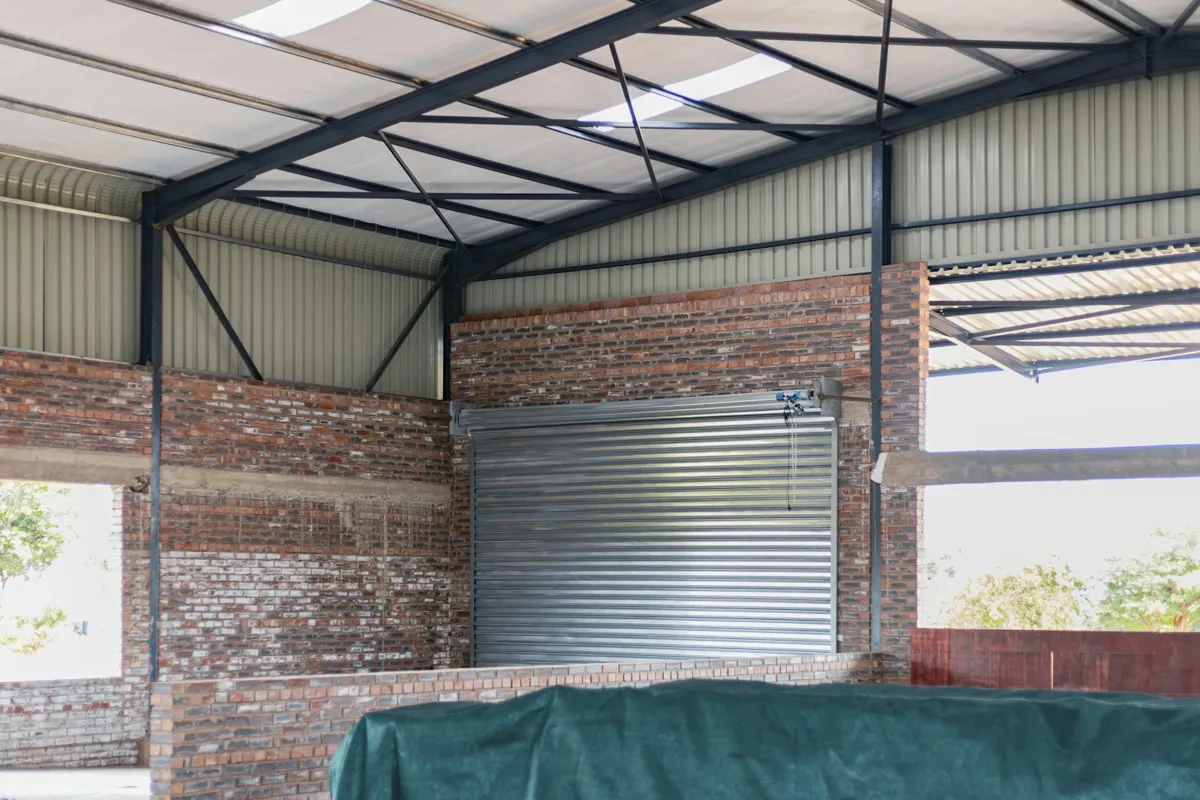
Most business buildings here use one of three door types. Sectional overhead doors are the panel doors on service bays and loading areas, often insulated, often with a row of windows. Rolling steel doors are slatted curtains that wind onto a drum over the opening, with their springs housed inside the drum and the curtain edges riding in steel guides.
The light corrugated roll-ups belong to storage lots and small shops, each with its own spring and a latch at the bottom. Rolling grilles guard storefronts and pass-throughs while keeping them visible. Around the county, metal buildings and ag shops add wide doors that see tractors and grain trucks.
Every one of them is worked on, from springs and cables to slats, panels, guides, motors and controls.
Hail that dimples a commercial door is not always a problem; a door with cosmetic dents can run fine for years. The trouble starts when a dent lands on a hinge line or creases a slat, because the door then catches as it travels, one side lags, and a cable starts carrying more than its share until it breaks long after the storm is forgotten.
The estimate separates the two. Panels and slats that cause binding are replaced one by one; dents that only spoil the look are noted so you can decide on them later. A whole new door is rarely the answer to a single storm.
Out past the city limits, steel buildings shelter tractors, combines and grain trucks behind some of the widest doors around. Those doors open less often than a city service bay, but each trip is a big one, and a door that sits for weeks between harvest runs can stiffen up, with dust and chaff packed into the rollers and track.
A visit to an equipment building covers the same ground as any commercial door: springs sized to the door, cables and drums, the track or guides, the operator if there is one, and the manual chain or release. Doors that have been patched over the years are written up honestly, with what is worth fixing kept apart from what is due to be renewed.
Business doors follow the same sequence, one door or ten.
Commercial door motors come in a few forms: a trolley unit that pulls the door along an overhead rail, a wall-mounted unit turning the spring shaft, and a hoist unit with a hand chain for raising the door when the power fails. Most are run from a station with open, close and stop buttons, and some close on a timer.
On a busy floor, the devices that stop the door matter more than the motor. A pressure-sensitive edge on the bottom of the door and a pair of eyes across the opening reverse it for a person, a forklift or a truck. Edges get crushed and eyes get knocked out of line all the time on a working dock, and those repairs go at the top of the estimate.
A warm afternoon followed by a hard freeze can lock a door's bottom seal to the slab overnight. Running the motor against a frozen door strips its gears or buckles the lowest section, so the door is freed first and the seal and the slab looked at, since a dip at the sill where water collects makes the problem come back.
Spring storms bring outages, and a motorized door still needs a way to open without power. Hoist motors have their hand chain; other units have a manual release. Whichever your door has is shown to the people who work there, and a surge protector is suggested for any new motor board.
Usually. Loose hinges and track bolts are tightened or replaced, struts are added on sectional doors, and rolling doors can take wind locks that keep the curtain in its guides.
Rarely. Panels or slats that make the door bind are replaced individually, and purely cosmetic dents are noted so you can decide on them separately.
A door that stops a business opening or closing is handled first, and the first goal on site is getting it working and secure.
Yes. Rolling grilles, storage-unit roll-ups, rolling steel doors and sectional overhead doors are all repaired.
Leave the motor switched off, since running it against a frozen seal strips gears and bends the bottom section, and give us a call.
Yes. Name each one when you call, and each gets its own lines on the estimate.
Yes, free either way, written door by door, and nothing starts until you approve it.
Describe the symptoms and you'll get an arrival window, not a guess. The visit and the estimate is free, anywhere in Sedgwick County.
Would rather call? Call (316) 749-2780.
Tell us what the door is doing. The estimate is free either way.