
Cables do the lifting on every garage door, but how they do it depends on the door. The older single doors on the east side lift through pulleys; the two- and three-car doors out west wind their cables onto drums. Both fail in their own way. If a cable is hanging loose or the door sits crooked, leave it shut and call. The estimate is free.
Tell us what the door is doing. The estimate is free either way.
Many of the 1950s ranches on the east side still have their original single door, lifted by extension springs that stretch along the ceiling beside each track. On those doors, each cable runs from the bottom corner up over a pulley and back, and the pulley does a lot of work. When its bearing wears, the pulley wobbles or stops turning, and the cable starts to fray where it rubs. When hail or wind has creased a section itself, our garage door panel replacement page explains what can be swapped on its own.
Cables and pulleys are replaced together on these doors, along with the safety cable that runs through each spring. That safety cable is what keeps a broken spring from whipping across the garage, and on older doors it's sometimes missing altogether.
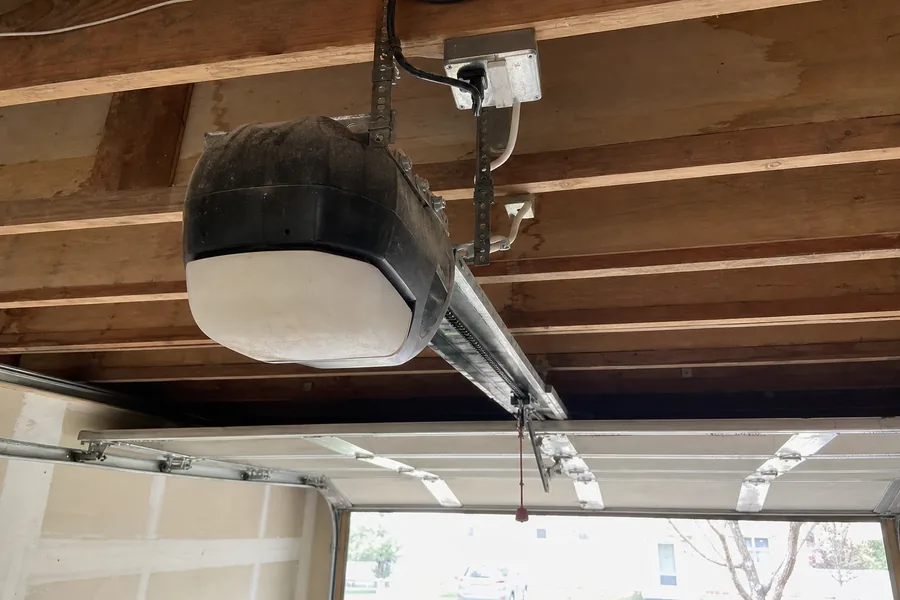
The newer subdivisions on the west and northwest sides went up with torsion springs, where the cables wind onto grooved drums at each end of a shaft above the door. On a wide door, the two cables are a long way apart, and if one side of the door drags or binds, the cable on the other side goes slack and can ride out of its groove.
A cable that has jumped its drum usually leaves the door hanging lower on one side. The drum is inspected when that happens, since a cable that jumped once can chew a groove that makes it jump again.
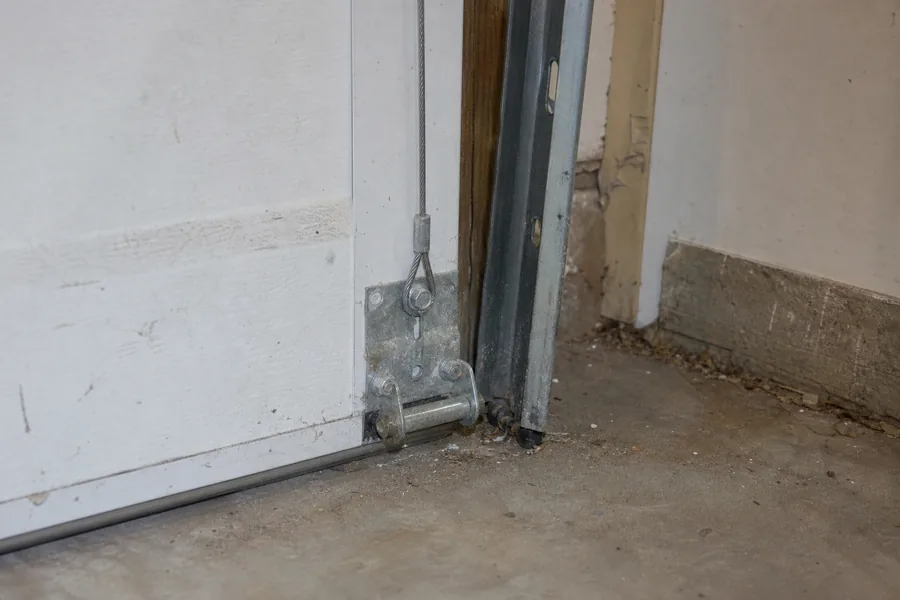
A hailstorm that dents the bottom sections, or a gust that bows a closed door inward, can leave the door slightly twisted. It still runs, but one side now lags the other, and the cables share the load unevenly. Over the following weeks the harder-working cable frays at its bottom bracket, and one morning the door goes up crooked.
After a storm has hit the door, a look at the cables, the bottom brackets and the rollers is worth the few minutes it takes, before anything lets go.
Safe first, then fixed.
After an ice storm, the bottom of the door can be frozen to the driveway. Running the opener then is the quickest way to throw a cable: one side lets go before the other and the slack cable slips off. If the door is iced down, wait for it to free up, or have us come out and free it properly.
A new bottom seal with a good lip, and a driveway that drains away from the door, cut down on how often it happens.
Wind in the spring and summer carries dust into every garage, and it collects in the tracks and the roller bearings. Rollers that grind with grit wear flat spots, make the door louder and heavier, and add to the strain on the cables. Plain steel rollers suffer most.
Sealed-bearing nylon rollers shut the dust out and keep running quietly. A full set goes in on both sides of the door, listed as its own line so you can decide.
Single doors in Riverside, College Hill and Crown Heights, larger doors in Eastborough and around Westlink, the older homes in Delano, and out to Derby, Andover, Haysville, Maize, Goddard and Park City.
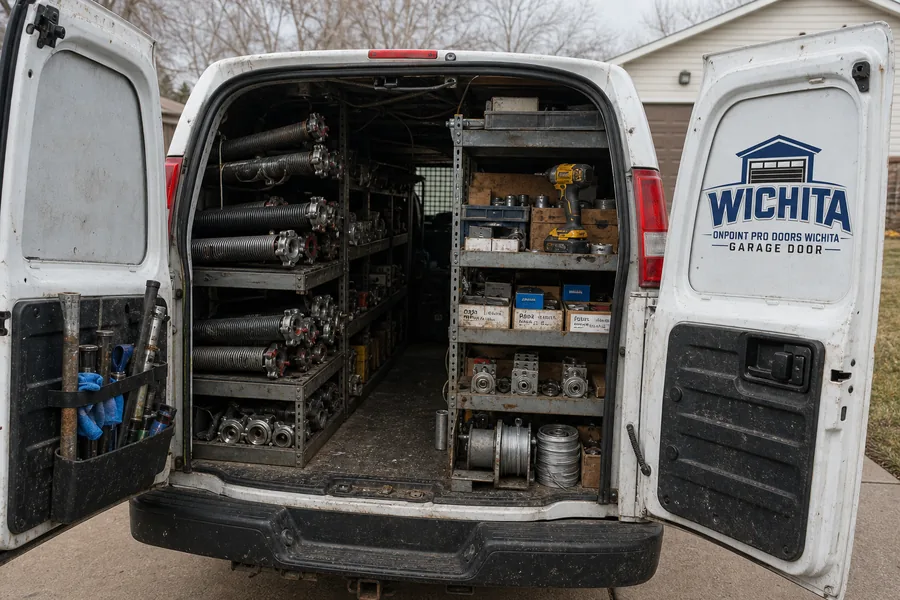
Cables, pulleys and drums in the common sizes are carried on the truck.
Both cables replaced together. One old and one new never wind alike.
Pulleys with the cables. On every extension-spring door.
A safety cable in every extension spring. Added where it's missing.
Tension off before anything else. No exceptions.
A cable has probably slipped off its drum or pulley. Leave the door alone, unplug the opener, and call; the door is secured before anything is touched.
A safety cable. It keeps a spring that breaks from flying loose. If yours doesn't have one, it's added during the repair.
Cables are replaced, never spliced, and always as a pair.
One side broke free before the other and a cable came off. Don't run the door; call and it's put right.
Usually dust in worn bearings. A set of sealed rollers fixes it and takes strain off the cables.
Yes, on shop and warehouse sectional doors as well.
Early calls are possible; say when you need the car out and the window is set around it.
It is. You'll get it in writing, part by part, before any work.
Tell us whether the door is hanging or stuck, and where; the slot you're given is two hours wide, and the technician phones before leaving for you.
Free estimate across the county, the suburbs included.
Describe the symptoms and you'll get an arrival window, not a guess. The visit and the estimate is free, anywhere in Sedgwick County.
Would rather call? Call (316) 749-2780.
Tell us what the door is doing. The estimate is free either way.