Hail and straight-line wind usually wreck one or two rows of a door and leave the rest sound. OnPoint Pro Doors replaces single sections across Wichita and the nearby towns when the original design is still built, adds struts where a wide door needs them, and resets the balance. Free estimate either way.
Tell us what the door is doing. The estimate is free either way.
After a hailstorm, the side of a door that faced the storm is usually peppered with small dents. Those are cosmetic, and plenty of doors carry them for years without trouble. The damage that matters is a crease: a dent near a hinge, or along the joint where two rows meet, that bends the row so it no longer folds cleanly.
A creased row binds where the track bends overhead. Binding shoves the rollers sideways, leaves one cable doing more of the lifting, and some weeks or months later the door rises crooked or a roller jumps out. That is why creases get replaced and ordinary dents generally stay.
Wind does its own version. A wide door that bowed inward during a gust can come back with a row bent along its length, which shows up as a gap at the middle of the door once it is closed.
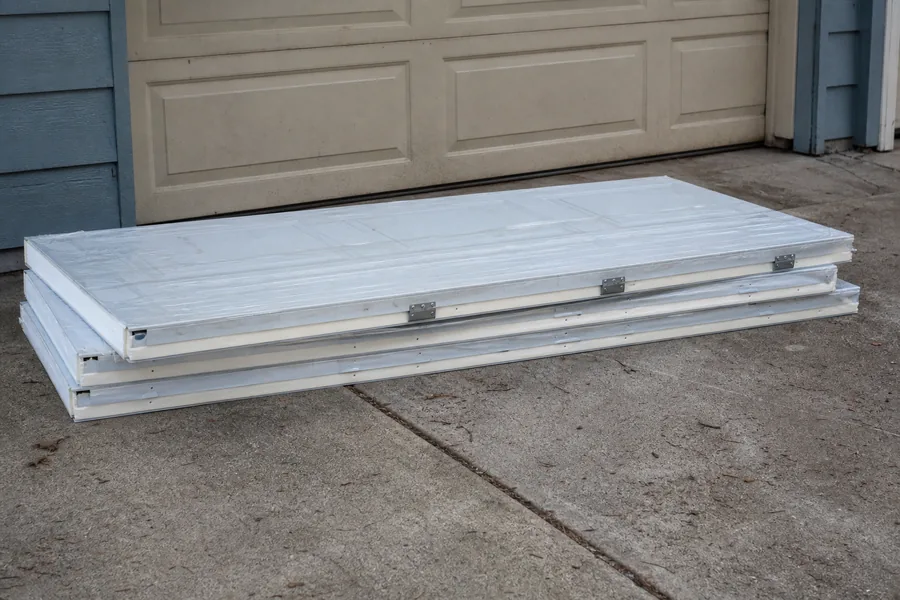
A replacement row has to agree with the rest of the door in width, height, thickness, panel pattern, insulation and grain, or it will sit proud of its neighbors and look like a patch. So nothing is promised until the maker's tag has been read, usually on the inside face near the top or at one end, and the design has been looked up.
Many of the wide doors in the newer subdivisions out west are designs still in production, so a creased row there can normally be ordered by itself. East-side doors are older, and some singles have not been made for decades.
When the row cannot be had, that comes first, together with what straightening and bracing the bent one might buy in time, and what a new door would involve instead.
Two- and three-car doors are wide, flat panels, and on open ground the wind leans on them often. Struts, steel braces running across the inside of the upper rows, keep them from bowing in a gust and keep the rollers seated when the gust lets go.
When a row is swapped on a wide door, its strut moves over to the new row, or a fresh one goes on in the same position. If the door never had struts and the damage came from wind, adding them across the upper rows during the swap is recommended and listed with the reason, so the next windy week does not bend the new panel as well.
Doors that face a field, a retention pond or a wide street take the hardest gusts. Those are the ones where a strut on every upper row earns its keep, and where a creased row is most likely to come back if nothing stiffens it.
East-side ranches built in the fifties often kept their original single doors, and some still lift on extension springs stretched along the ceiling instead of a torsion spring above the opening. Swapping a row on one of those doors is a natural moment to look at the springs, the pulleys and the safety cables threaded through each spring, since all of them tend to be original too.
If the design is long gone and several rows are tired, a new insulated single door on a torsion spring is written up next to the repair. On those houses it is often the better long-term answer, though the call stays with the homeowner.
Replacement rows ship in the original factory paint, while the rest of the door has been weathering on the plains for years. White and almond doors usually hide the difference; darker colors can give it away.
Grain and pattern count as much as color. A wood-grain row among smooth ones is obvious from the street, and so is a long-panel row in a short-panel door. The sample gets held up against your door before ordering, and painting the whole door afterward closes the gap if the match falls short.
Most jobs take two trips: one to identify and measure, one to install when the row arrives.
Hail that creased most of the rows, a design that is no longer built, or a door that is also due for springs, cables and rollers tips the decision toward a new door. On this side of the state, a heavier insulated door with a grained skin also takes the next hailstorm far better than the thin one it replaces.
You get the repair and the replacement on one sheet, each with its reasoning, and you pick. The written estimate lists the damage row by row, which also makes it easy to see exactly what the storm did.
In many cases. If the manufacturer still produces that design at your door's size, thickness and grain, the creased row goes in by itself; the tag inside the door is how that gets confirmed.
Usually only where a dent has turned into a crease near a hinge or along a joint. Those rows bind as the door rolls up; dents in the open face of a panel are just marks.
Steel braces across the inside of the rows that keep a wide door flat in the wind. Wide doors facing open ground benefit most, and they are added during a swap when the door calls for them.
The pattern will. Whether the color matches depends on how much the existing paint has weathered, so a sample is held against the door before ordering. Repainting the door is the fallback if it shows.
A matching row cannot be bought, so that is the first thing you hear. A bent row can sometimes be straightened and braced to buy time; past that, a new door is the straight answer.
Because the new row rarely weighs what the creased one did. Springs tuned to the old weight would leave the door drifting, and the opener would end up making up the difference.
Yes. The damage is gone over row by row and the options explained, and the estimate is free before any part is ordered.
Describe the symptoms and you'll get an arrival window, not a guess. The visit and the estimate is free, anywhere in Sedgwick County.
Would rather call? Call (316) 749-2780.
Tell us what the door is doing. The estimate is free either way.